Quick context: Why the D2C “gold era” ended
Between roughly 2018–2022, many D2C brands benefited from tailwinds:
- Lower and easier customer acquisition
- More reliable ad targeting and measurement
- Stronger organic reach on social platforms
- Lower competitive intensity in many categories
Then the environment changed quickly—competition increased, costs rose, and measurement became less certain. At the same time, many founders scaled faster than their unit economics could adapt.
What the “50 crore wall” really means
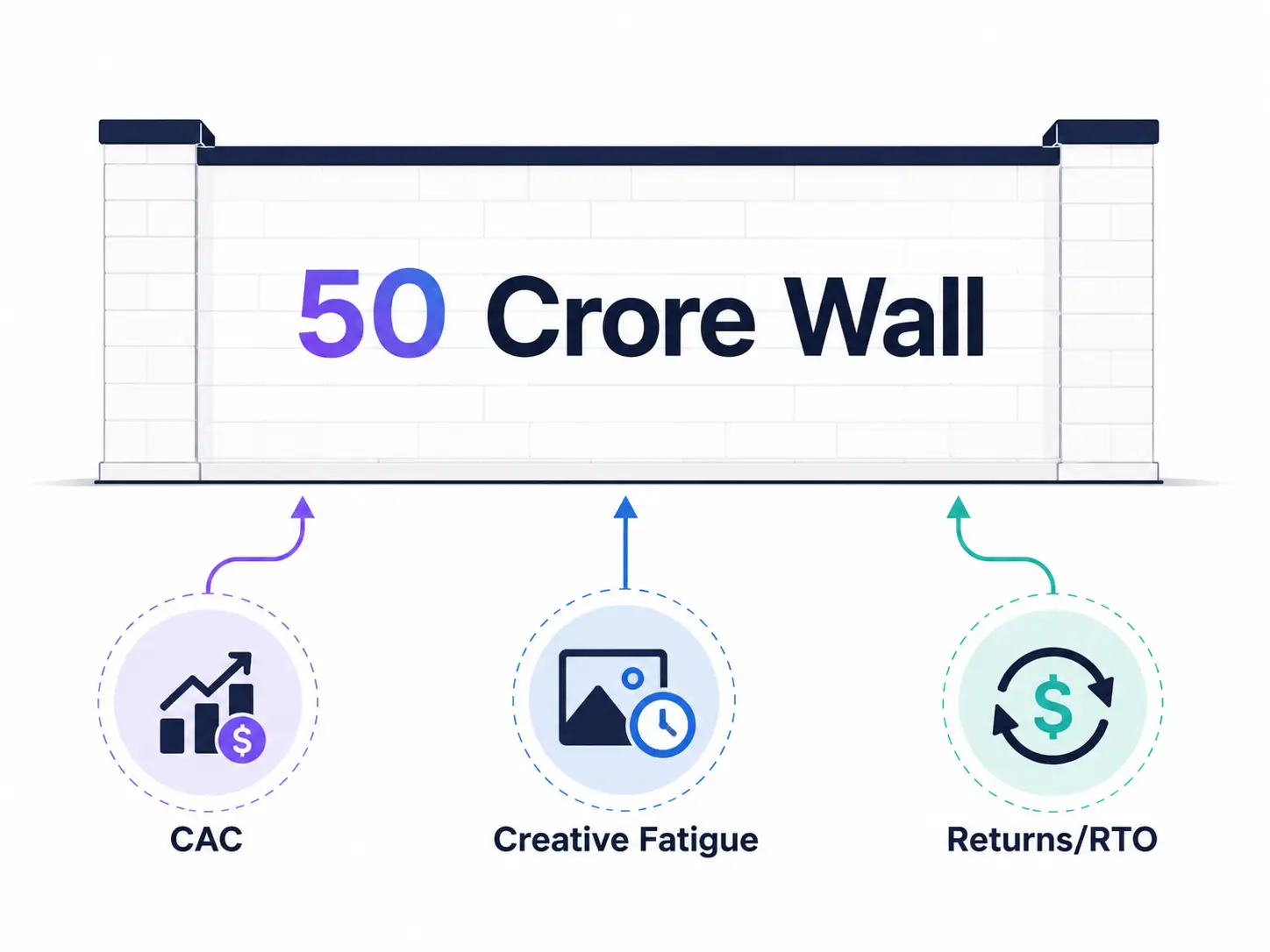
The “50 crore wall” is not a single metric. It’s when multiple constraints overlap:
- You’ve already captured the easiest-to-convert customers
- You start targeting harder audiences that your competitors also pursue
- Paid media becomes more dependent on creative quality and landing-page conversion
- Operational complexity increases (returns, RTO, refunds, packaging, delays)
- Fixed costs rise with team size, warehouses, inventory, and compliance
So growth stops being only an execution problem and becomes a unit economics + operations problem.
The 3 hidden reasons most decks don’t explain
Reason #1: CAC inflation hits a ceiling—and margin collapses
Early on, CAC often looks manageable. But as revenue scale increases, you typically face:
- Audience exhaustion and increased reliance on broader targeting
- Auction pressure because more brands compete for the same impressions
- Higher blended CAC across product lines and channels
The dangerous part: revenue can still grow while contribution margin deteriorates. If contribution goes negative, the business can “look alive” while it quietly burns capital.
Reason #2: Creative fatigue becomes a growth tax
In D2C, creatives are not just ads—they’re your conversion engine. When competition increases, creative performance degrades through:
- Message saturation (same format, same hook, same angle stops working)
- Competitors winning attention with better proof and storytelling
- Higher dependence on iteration speed and creative rotation
That’s why “spend more” stops solving the problem. Winners engineer creative like an ongoing system: new angles, stronger value props, and performance-driven iteration.
Reason #3: Operational leaks (returns/RTO/logistics) destroy contribution margin
Many teams track CAC and AOV, but ignore post-purchase economics until scale hurts. Operational costs often rise at the exact moment you scale order volume.
- Returns and refunds increase
- RTO (Return To Origin) becomes a meaningful percentage
- Re-packaging and reshipping add extra cost
- Delivery delays increase cancellations and repeat churn
Result: your cost-to-serve rises, and your per-order profitability turns fragile.
News-style reference: why attribution and measurement get harder
Platform ecosystems increasingly optimize around ad relevance and system-level ad delivery mechanics—not just “targeting.” For example, Google’s documentation on ad performance highlights that ad position and performance depend on multiple factors including bid and expected impact, alongside the quality of the ad/landing page (Ad Rank concepts).
- Reference: Google Ads Help Center — Ad Rank overview: https://support.google.com/google-ads/answer/1722122?hl=en
Founder takeaway: as measurement becomes less precise, the business must become more robust through better landing-page conversion, stronger proof, and operational reliability—not only by spending more.
How winners break the wall: a practical playbook
Play #1: Engineer unit economics end-to-end (not only CAC)
Track contribution margin after:
- COGS
- Returns and refunds
- Shipping and logistics
- RTO leakage
- Discounts and credits
If contribution margin isn’t stable, scale becomes a risk—not an achievement.
Play #2: Build trust as an infrastructure layer
When paid costs rise, conversion depends more on trust signals:
- Founder/team credibility
- Customer proof (reviews, UGC, before/after)
- Clear product education (how to use, why it works)
Strong D2C content is not “reach content.” It’s proof-and-conversion content.
Play #3: If you go offline, treat it like unit economics—not brand theater
Offline can expand distribution, but it can also compress margins due to:
- Retailer/trade economics
- Settlement delays and returns handling
- More promotions and channel-specific discounts
Rule: offline expansion should be reverse-calculated from contribution margin requirements.
Play #4: Reduce RTO/returns with operational discipline
Common ways to reduce RTO/returns include:
- Address validation and checks before dispatch
- Proactive customer updates (e.g., WhatsApp/email)
- Faster fulfillment and reliable delivery execution
- Better packaging/QC to reduce damaged product returns
- City/region-wise inventory setups to improve delivery performance
7-question survival checklist for D2C founders
- Is my CAC stable by cohort?
- What is my true contribution margin after returns + logistics?
- How much of performance comes from creative rotation vs targeting vs landing-page conversion?
- Are landing-page conversion rates improving or plateauing?
- Is retention real repeat purchase (cohort-based), not just re-attribution?
- Can I deliver profitably by city/region?
- Do I have runway until unit economics stabilizes?
FAQ
What is the “50 crore wall” in D2C?
It’s the point where D2C scaling becomes harder because CAC rises, creative performance fatigues, measurement gets less reliable, and operational leakage starts damaging contribution margin.
Does every D2C brand fail after 50 crore?
No. Some break through by engineering unit economics, strengthening conversion infrastructure (proof + landing pages), keeping creative effective, and maintaining operational discipline.
How do privacy and tracking changes affect D2C?
They reduce the precision of attribution and targeting for some users, which increases reliance on cohort-based learning, first-party data, landing-page improvements, and creative quality.
What is the biggest hidden cost at scale?
Often it’s returns/RTO/logistics and the operational cost-to-serve—not just paid media.
How can founders reduce returns and RTO?
By validating addresses, improving delivery execution, using proactive customer communication, speeding fulfillment, and improving packaging/QC to reduce damage-related returns.
Final takeaway
The “50 crore wall” is not destiny. It’s a systems problem: paid growth + creative + measurement + operations must work together. Most brands don’t fail because they can’t sell—they fail because they scale the wrong parts of the funnel while unit economics quietly breaks.